April 17, 2026
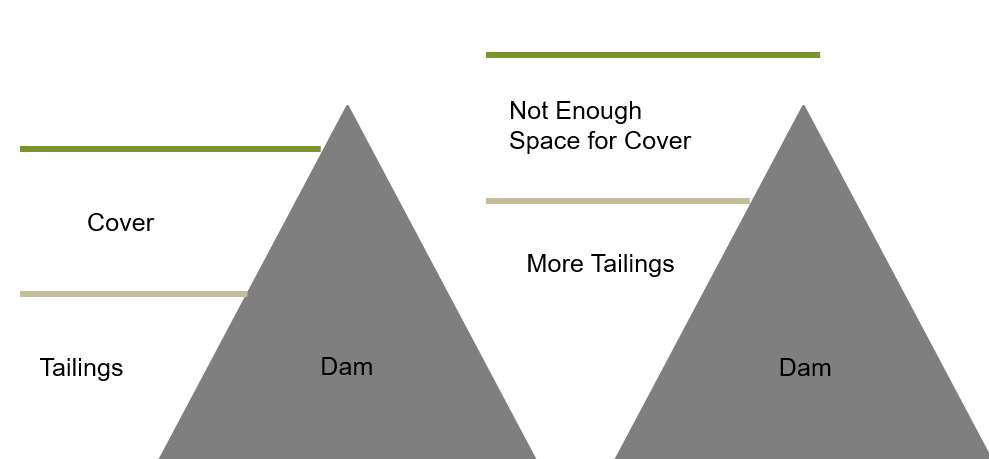
Change is constant at operating mines. Sometimes change is a response to operational realities. Sometimes change results from a substantially modified mine plan. Often, these changes happen without much regard for how they impact execution of the site’s closure plan. This may occur because the format of the closure plan isn’t useful in operational decision-making and medium-term planning.
Here, I share two concepts that can help bridge those gaps. I use tailings management examples throughout, but these ideas can be applied to other mine infrastructure.
Critical Constraint*: A physical limit placed on infrastructure so that the closure plan can be executed as intended.
A few examples of Critical Constraints for tailings facilities are:
- The closure spillway location and inlet elevation
- The maximum tailings elevation to leave room for a planned cover
- The maximum extents of a dam to allow sufficient space to build buttresses or flatten slopes, if these are part of the closure plan
Critical Constraints translate key elements of a closure plan into spatial realities that can be included in day-to-day management and longer-term planning. For tailings facilities, these can be incorporated into the facility’s Operations, Maintenance, and Surveillance manual.
Critical Threshold: A physical value that, if exceeded, creates a step change in impact to the landscape that must be addressed at closure.
A few examples of Critical Thresholds for tailings facilities:
- Significantly increasing the catchment area of the facility, e.g., by shifting from a side hill to a cross-valley impoundment
- Extending impacts into another watershed, e.g., by diverting surface water away from a tailings facility and into another watershed, or placing tailings to an elevation where groundwater impacts result in adjacent valleys
- Depositing potentially acid generating material within a tailings facility
Critical Thresholds highlight physical realities where changes to the mine plan create impacts that could affect the degree of effort required for closure, or how it’s implemented.
It’s not that a project can’t exceed its Critical Constraints or Critical Thresholds. It can. With the knowledge of how those changes affect closure, the project can explore operational alternatives that might negate impacts on closure execution and/or allow it to update the closure plan (and subsequent operations) to match the changes.
Critical Constraints and Thresholds can be identified in a workshop format, involving tailings management, mine planning & operations, and environmental leads. The current closure plan is reviewed in context of the existing operation and the Critical Constraints defined. Then, using their understanding of the site, participants can map the site’s Critical Thresholds. Most Constraints and Thresholds can be spatially defined and built into the project’s spatial databases and other operational & planning tools.
Getting clear on the project’s Critical Constraints and Thresholds transforms the closure plan from a document on a shelf to useful, spatially defined bases for operational decision-making and life of mine planning.
*In defining critical constraints, I’ve built on the idea of ‘constraint mapping’, presented by the Landform Design Institute and Gord McKenna. Section 4.5.11 of the LDI’s Developing a Design Basis Memorandum for Landform Design describes constraint maps.